The Stretches Your Tight IT Band Needs
If your hips or knees have been giving you grief, your IT band might be the culprit. Here's how to sort it out.

February 23, 2026 - Updated February 23, 2026
We've all been there. You finish a run, a hike, or a solid leg day, and suddenly there's this weird ache on the outside of your knee or hip that just won't quit. Nine times out of ten? The issue isn’t actually with your knees and hips - it’s your IT band. The good news is that a few targeted stretches done consistently can make a massive difference, and you don’t need to spend hours on the mat to feel the benefit.
What actually is your IT band?
The iliotibial band (aka your IT band), is a thick band of connective tissue (fascia) that runs along the outside of your thigh, from your hip all the way down to your knee. It's not a muscle, which is why it can feel a bit stubborn when you try to stretch it. Its job is to stabilise your knee during movement, which means it takes a lot of load when you're running, cycling, hiking, or doing lateral movements in the gym.
Why does the IT band get so tight?
Life, mostly. This part of the body is tight for a lot of people due to things like:
Repetitive movement patterns
Weak glutes and hip abductors
Too much sitting
Ramping up your training load too quickly
Not giving your body enough recovery time
When the muscles around the IT band — particularly the TFL (tensor fasciae latae) at the hip — get overworked or tight, the tension travels down the band and causes that familiar nagging pain on the outside of your knee or hip.
IT band syndrome is one of the most common overuse injuries in runners, but it's not exclusive to runners. Desk workers, cyclists and anyone who does a lot of repetitive lower-body movement can feel it too.
Why IT band stretches should be part of your routine
You can't technically "stretch" the IT band itself in the same way you can a muscle, because fascia doesn't have the same elasticity. But what you can do is release tension in the surrounding muscles like your TFL, glutes, hip flexors and lateral quads. This reduces the pull on the band and gives you significant relief.
Regular IT band stretching also helps maintain hip mobility, supports better movement mechanics, and can prevent that annoying lateral knee pain from developing in the first place. Think of it as essential maintenance for your body so you don’t end up needing to fork out dollars in the repairs shop.
Foam roller IT band release
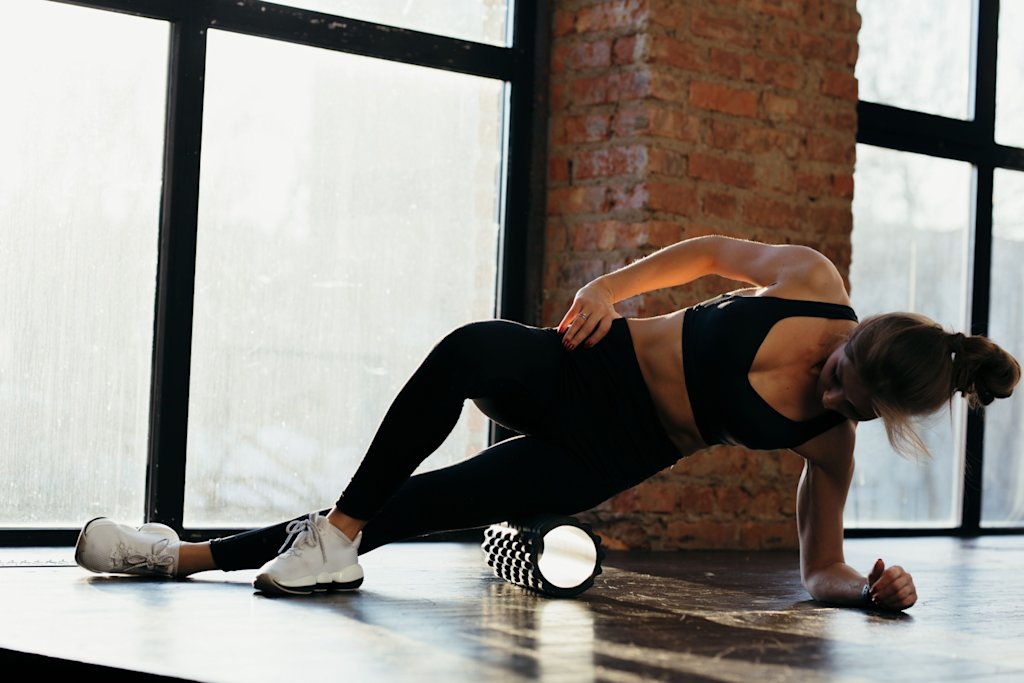
Place a foam roller on the floor and lie on your side, positioning it just below your right hip.
Stack your legs or cross the top leg in front for support, taking some weight through your top foot.
Slowly roll from your hip down to just above your knee, pausing on any tender spots for 20–30 seconds then switch sides.
Avoid rolling directly over the knee joint.
Tip: It might be a little uncomfortable — that's normal. But sharp or intense pain is a sign to ease off the pressure.
Figure four stretch (piriformis and TFL release)
Lie on your back with both knees bent, feet flat on the floor.
Cross your right ankle over your left thigh, just above the knee, flexing your right foot.
Either stay here for a gentle stretch, or lift your left foot off the floor and draw your left knee toward your chest to intensify it.
Hold for 30–45 seconds. You should feel it deep in the right glute and outer hip.
Repeat on the other side.
Tip: Keep your hips flat on the floor and avoid letting your lower back arch away from the mat.
Standing IT band stretch
Stand tall with your feet together.
Cross your right foot in front of your left, so both feet are close together and your right foot is slightly to the left.
Reach your right arm up and over your head, leaning to the left side. You should feel a stretch down the right outer hip and thigh.
Hold for 30–45 seconds, breathing steadily.
Switch sides and repeat.
Tip: Push your hips out to the side (away from your lean) to deepen the stretch.
Low lunge with lateral reach (hip flexor and TFL stretch)
Start in a low lunge with your right foot forward and left knee on the floor.
Reach your left arm up and then lean to the right, creating a long line from your left knee to your fingertips.
You should feel a stretch along the left hip flexor and the outer left hip.
Hold for 30 seconds, breathing into the stretch.
Switch legs and repeat on the other side.
Tip: Keep your front knee tracking over your second toe and avoid collapsing through the lower back.
Supine IT band stretch with recovery band
Lie on your back with both legs extended and a resistance band looped around your right foot.
Hold both ends of the band in your left hand, keeping your right arm extended out to the side for stability.
Lift your right leg up toward the ceiling, keeping it as straight as comfortable.
Slowly guide your right leg across your body to the left using the band, letting it lower toward the floor. Your right shoulder should stay flat on the mat throughout.
Hold for 30–45 seconds, breathing steadily. You should feel the stretch along the outer right thigh and hip.
Slowly bring the leg back to centre, then lower it down.
Repeat on the other side.
Tip: The band gives you much more control than using your hand alone, but use it to guide the leg rather than yank it. A slow, steady pull will get you a better stretch every time.
Make recovery a regular thing
IT band tightness is incredibly common and, the good news, very manageable. Adding these five stretches to your post-workout routine (or even just to your morning or evening wind-down) can seriously reduce discomfort, improve your hip mobility and keep you training consistently without that nagging lateral pain creeping back in. The keyword here is consistently. One foam rolling session won't undo months of tightness, but five minutes done regularly will. Your knees will thank you for it.
Erin is a writer and editor at Sweat with years of experience in women's publishing, the fitness industry, media and tech. She's passionate about the power of movement, and you can often find her on a yoga mat, a hike, a dance floor, in the ocean or the gym.
* Disclaimer: This blog post is not intended to replace the advice of a medical professional. The above information should not be used to diagnose, treat, or prevent any disease or medical condition. Please consult your doctor before making any changes to your diet, sleep methods, daily activity, or fitness routine. Sweat assumes no responsibility for any personal injury or damage sustained by any recommendations, opinions, or advice given in this article.
Fitness