8 Of The Best Kettlebell Exercises To Build Full Body Strength
Eight kettlebell exercises that cover every movement pattern your body uses, with helpful form tips and a progression for when you're ready to level up.

September 22, 2026 - Updated September 22, 2026
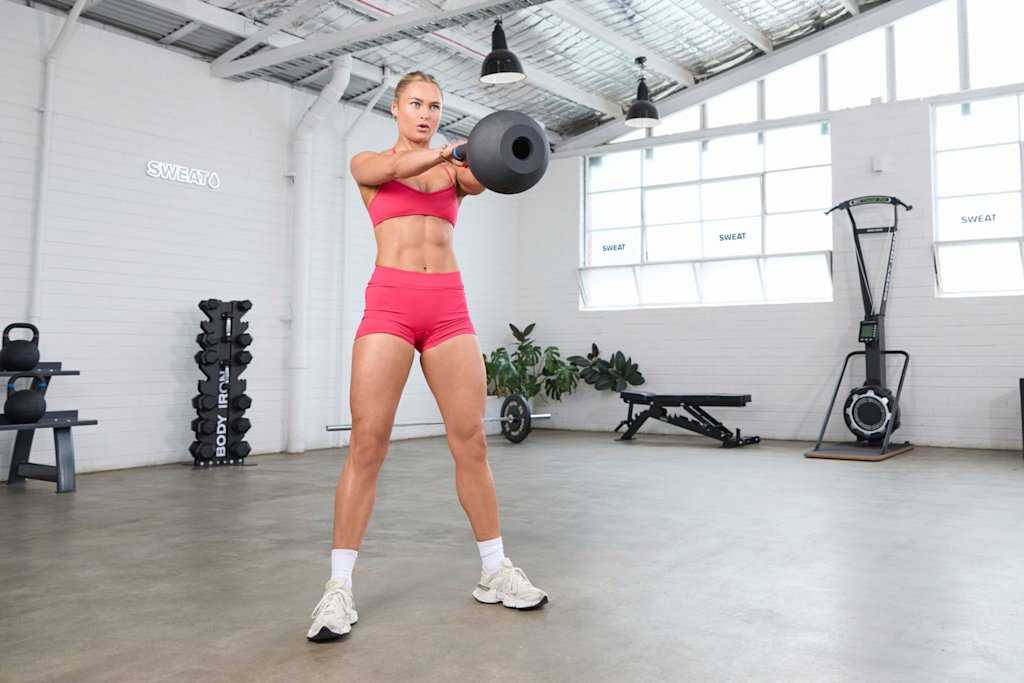
Kettlebells remain a super under-utilised piece of equipment.
We totally get it if you're training at home or buying your very first set of home equipment - a kettlebell honestly isn't one of the first things we'd recommend investing in. Those things would be a good set of adjustable dumbbells, a bench and some resistance bands (or whatever your chosen program calls for).
But if you're working out in a fully equipped gym or expanding your home gym setup, we LOVE using kettlebells. They're a solid way to build power, strength, functional coordination and fitness.
Our go-to kettlebell exercises are the ones that train the movement patterns your body already uses every day: squatting, hinging, pushing, pulling, carrying and lunging.
Here are the eight moves we'd start with, form tips and how to level things up with more advanced variations.
Why kettlebells are worth the space in your home gym
As Harvard Health explains, kettlebells have been around for centuries and they're still around today for good reason. They're great for every fitness level, work several muscle groups at once, and support balance, cardio conditioning, bone health, and posture, too.
They're also fun to use and an effective way to add some novelty to your training. If you've been feeling a bit bored with dumbbells, switching to kettlebells can help to spice things up and challenge your body and brain in new ways.
The 8 best kettlebell exercises for beginners
We recommend mastering these in order, but depending on your fitness and strength level, you do you.
The first four teach the patterns everything else is built on, so if this is your first time picking up a kettlebell, it's worth spending a few sessions on those before moving on.
If you want to try these exercises but don't have a kettlebell, most of them can also be performed with dumbbells.
Goblet squat
Hold the kettlebell by the handle, or flip it and grip the round bell - whatever feels more natural. The main thing is to keep the weight close to your chest, elbows tucked in. Stand with your feet a little wider than your hips, toes turned slightly out. Push your hips back and bend your knees to lower down, keeping your chest tall. Drive through your feet to stand back up and squeeze your glutes at the top.
Muscles worked: quads, glutes, adductors, core and upper back.
Form tip: holding the weight at your chest acts as a counterbalance, which helps you stay upright. If your heels lift at any point, try a slightly wider stance.
When you're ready for more: pause for two seconds at the bottom of each rep, then progress to a heavier weight or try a front rack squat, where you hold a kettlebell in each hand by the handle and rest the weighted bell on the back of your forearm.
Sumo deadlift
Stand in a wide stance with the kettlebell (or two if you want more of a challenge) on the floor between your feet. Push your hips back, soften your knees and reach down with a flat back to grip the handle with both hands. Drive your hips forward to stand up straight, then lower the kettlebell back to the floor with control.
Muscles worked: glutes, quads, hamstrings, adductors (inner thighs) and upper back.
Form tips: think about pushing the floor away rather than pulling the bell up. Any deadlift variation should feel very different from a squat, so make sure you're focusing on pushing your hips back towards the wall behind you, rather than bending your knees like you're sitting into a chair.
When you're ready for more: move to a single-leg deadlift, try a traditional deadlift (feet hip-width apart) or RDLs for some variation, or go heavier.
20 seconds
Kettlebell swing
Set up as you would for a kettlebell deadlift (feet hip-width apart and kettlebell between your feet), then once you've picked the weight up, let it swing back between your legs like you're passing a ball behind you. Thrust your hips forward to stand tall and propel the kettlebell up to chest height. Let it swing back down between your legs and repeat.
Muscles worked: glutes, hamstrings, core and shoulders, with a pretty decent cardiovascular hit.
Form tip: this is a hinge, not a squat, and it's not a front raise either. Think hips back, thrust forward (no squat involved at all). Your lower body is doing almost all the work, and your arms are just along for the ride. EMG research shows the glutes produce the largest peak activation during the swing, so if you're feeling it mostly in your lower back or shoulders, the hips aren't doing enough of the work.
When you're ready for more: progress to a heavier weight or single-arm swings, which demand more from your core to resist rotation.
Upright row
Stand tall with the kettlebell in both hands, arms straight, the bell resting in front of your thighs. Pull it up towards your collarbone, leading with your elbows and keeping the bell close to your body. Lower it slowly back to the start.
Muscles worked: side delts, traps, upper back and biceps.
Form tip: keep your hands roughly shoulder-width apart and stop pulling once your elbows reach shoulder height. Going higher than that, or gripping too narrow, tends to bother the shoulders for a lot of people. If you feel any pinching, pull to chest height instead and you'll still get plenty out of it.
When you're ready for more: slow the lowering phase to three seconds or go heavier.
20 Reps (10 Per Side)
Gorilla rows
Set two kettlebells on the floor just inside your feet, stand with a wide stance and hinge forward with a flat back until you can reach the handles. Row one bell up towards your hip, leading with your elbow, then lower it under control and repeat on the other side. Keep alternating.
Muscles worked: lats, rhomboids, traps, rear delts, biceps, with your core working hard to stop you twisting.
Form tip: the bell that stays on the floor is your anchor, so keep your hips square and resist the urge to rotate as you pull. If your shoulders are seesawing, the weight is winning. Slow it down and go lighter.
When you're ready for more: go heavier, pause for a second at the top of each row, or stop letting the bell touch down between reps so your back is under tension the whole set.
Farmer's carry
Hold a kettlebell in each hand by your side. Stand tall, brace your core and walk. Keep your shoulders level and resist the pull to one side. Walk for 20 to 30 seconds.
Muscles worked: obliques, deep core, glutes, upper back and grip.
Form tip: the work here is resisting the pull, so if you're tipping towards the weight and struggling to keep your posture upright, go lighter and walk taller.
When you're ready for more: switch to an overhead carry or heavier weights.
Reverse lunge
Hold the kettlebell at your chest. Step one foot back and lower until your back knee is just above the floor. Push through your front heel to return to standing.
Muscles worked: glutes, quads, hamstrings, calves and core.
Form tip: stepping backwards is kinder on the knees and balance than stepping forwards, which is why we start people here. Keep most of your weight in your front leg.
When you're ready for more: hold the bell in the front rack on one side only, try forward lunges, go heavier, or progress to a Bulgarian split squat.
Clean & jerk
Okay, this one is definitely more advanced, but it's a fun one to aim for, and you can practice each part of the movement before stringing it all together.
Start as you would for a one-arm kettlebell swing, but as the bell comes forward, pull your elbow in and let your hand slide around the handle so the bell lands softly against your forearm in the front rack position. Dip your knees and drive hard through your legs to launch the bell upwards. As it rises, dip a second time and drop underneath it, catching it overhead with a locked-out arm. Stand tall to finish, then lower it back to the rack.
Muscles worked: almost everything. Glutes, hamstrings, quads, shoulders, triceps, core and grip, with a serious cardiovascular cost when you string reps together.
Form tip: the second dip is what makes this a jerk rather than a press. If your arm is straining to push the bell the last few inches, you're pressing it. Drive with your legs, then get under it quickly. It should feel like the bell stays roughly where it is while you drop beneath it.
Before you try it: this is a more advanced exercise, so if you're new to these movements, make sure you're comfortable with the swing, the clean, and a strict overhead press separately first.
What weight kettlebell should you start with?
For most women new to kettlebells, an 8kg (around 18lb) bell is a sensible starting point for pressing and single-arm work, and a 10-12kg (around 26lb) bell is often better for swings, deadlifts and squats where you've got the power of your lower body doing the work.
This is why we don't necessarily recommend adding kettlebells to your home gym set-up when you're just starting out or limited on space. It pays to have a few options!
Where to start if you only remember one thing
You really don't need to overcomplicate kettlebell training.
Grab a kettlebell whenever you can to build your confidence. Start with the goblet squat and the deadlift. Get comfortable hinging. Then add the swing, and build from there. The progressions will come with time!
Erin is a writer and editor at Sweat with years of experience in women's publishing, the fitness industry, media and tech. She's passionate about the power of movement, and you can often find her on a yoga mat, a hike, a dance floor, in the ocean or the gym.
* Disclaimer: This blog post is not intended to replace the advice of a medical professional. The above information should not be used to diagnose, treat, or prevent any disease or medical condition. Please consult your doctor before making any changes to your diet, sleep methods, daily activity, or fitness routine. Sweat assumes no responsibility for any personal injury or damage sustained by any recommendations, opinions, or advice given in this article.
Fitness