How To Do Bulgarian Split Squats: Form, Benefits & Progressions
Your complete guide to one of the best lower-body exercises.

August 18, 2026 - Updated August 18, 2026
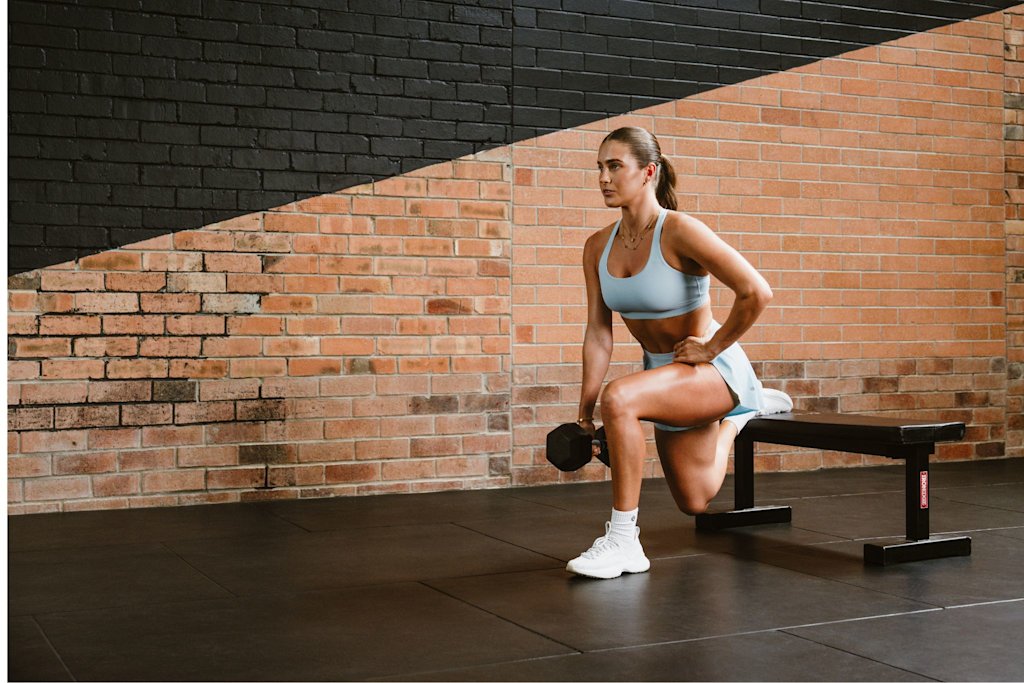
Most of us have a love-hate relationship with Bulgarian split squats.
They're so effective for building lower-body strength. They're an amazing unilateral exercise for addressing muscle imbalances. And they don't need much equipment. But far out, they hurt and can make even a relatively light dumbbell feel heavy.
Also known as a rear-foot-elevated split squat, the Bulgarian split squat is a single-leg lower-body exercise that challenges your strength, balance and control. Your front leg does most of the work while your back foot rests on a bench or elevated surface.
The setup can feel a bit awkward at first, so let’s break down exactly how to do Bulgarian split squats with good form and how to make them easier or harder as you get stronger.
What muscles do Bulgarian split squats work?
Bulgarian split squats primarily work the quadriceps and glutes of your front leg. Your hamstrings and adductors also come to the party, while your core and hip stabilisers work to help you stay balanced and controlled.
Because you’re working one leg at a time, the exercise also gives you an opportunity to work on any strength imbalances that can be harder to notice when you're doing bilateral exercises such as squats or hip thrusts.
Your setup can also change where you feel the exercise most. Performing Bulgarian split squats with a more upright torso generally increases the emphasis on your quads, while a slight forward lean can shift the focus to your glutes and hamstrings.
Benefits of Bulgarian split squats
They build single-leg strength. Training one leg at a time means the working leg can’t share the load, so it has to do more of the work than it would during a two-legged exercise.
They help address muscle imbalances. Most of us have a stronger side. Single-leg exercises make those differences obvious and give you a way to work on them.
They challenge your balance and control. Your hip stabilisers and core have to work throughout every rep, which carries over to everyday movement and other exercises.
They’re demanding without needing heavy loads. Because one leg is doing most of the work, you can create a strong training stimulus with lighter dumbbells than you’d need for a barbell squat or even a lunge.
They need very little equipment. A bench, box, or sturdy chair and a pair of dumbbells is enough, making them a practical option for almost any setup.
How to do a Bulgarian split squat
What you need: A sturdy bench, low box or elevated surface, roughly knee height or lower. If the surface is too high, it can push your hips into a position that’s harder to control, so when in doubt, go lower.
Stand in front of a bench with your back facing it (two dumbbells optional). Place one foot behind you on the bench, with the top of your foot resting on the surface.
Step your front foot forward far enough that you have room to lower down without your front heel lifting from the floor. You may need to adjust your stance slightly to find a comfortable position.
Brace your core and keep your chest lifted. Most of your weight should stay through the front leg, with your back leg providing support rather than doing the heavy lifting.
Bend your front knee and hip to lower your body towards the floor with control.
Lower until your front thigh is roughly parallel to the floor and your back knee is travelling towards the ground. Your comfortable depth will depend on your mobility and control, so treat this as a guide rather than a rule.
Drive through your front foot to return to standing, keeping your knee tracking in line with your toes.
Complete your reps on one side before switching legs.
The exact stance that works best will vary slightly from person to person, so don’t worry if your setup looks a little different from someone else’s. Finding a position where you can move comfortably, maintain control and feel the right muscles engaging is more important than forcing your foot into a specific spot.
How many sets and reps should you do?
As a general guide, 2–4 sets of 6–12 reps per leg suits most strength goals. Start at the lower end of both ranges while you’re learning the movement, and only add reps or weight once you can complete every rep with the same quality of control.
As you get stronger and more confident, you can adjust your rep and set ranges based on your goals. For strength goals, lift heavier weights for 6-8 reps. For muscle-building and hypertrophy goals, a moderate-to-heavy weight for 8-12 reps is the sweet spot.
Bulgarian split squat form tips
It's normal to feel a bit wobbly when you first try this exercise, but if Bulgarian split squats consistently feel more like a balance exercise than a strength exercise, your setup may need a tweak.
Give yourself enough distance from the bench. Standing too close is the most common setup issue, as it can make it hard to lower comfortably and can push your front knee into an awkward position. A simple hack: sit on the bench with your legs extended in front of you, then stand up with your feet in the same spot.
Keep your front foot fully grounded. Think about pressing through your whole foot, particularly your mid-foot, as you drive back up. Don't let your heel or toes lift.
Use your back leg as support, not as your main source of power. Your front leg should be doing most of the work. If you feel yourself pushing heavily through the foot on the bench, reset your position so you're feeling the work in your front leg.
Keep your front knee tracking over your toes. Try to avoid letting the knee collapse inward as you lower or stand.
Control the lowering phase. Rather than dropping quickly into the bottom of the movement, take your time on the way down and maintain control throughout the full rep. That's where the strength gains happen. If you’re wobbling or bouncing out of the bottom with momentum, reducing the weight will usually give you a better-quality rep.
Don’t worry about staying perfectly upright. A small forward torso lean is completely normal, and it can shift the emphasis toward your glutes and hamstrings if that's what you want to target.
Find your comfortable range of motion. You don’t need to force yourself into a particular depth straight away if you can’t maintain good control. As your mobility, strength and confidence improve, your range of motion will progress with you.
How to progress Bulgarian split squats
You don’t need to start with heavy dumbbells. Mastering the movement with your bodyweight first will serve you far better in the long run.
Work through these variations in order (or start with whichever variation suits your current strength level), moving on only when you can complete 8-12 reps with control and good form.
1. Split squat
If a full split squat is really challenging, start with both feet on the floor. You’ll still build single-leg strength in a stationary lunge position without the balance challenge of elevating your back foot.
2. Supported Bulgarian split squat
Next, elevate your back foot (a lower surface like a step is completely fine) and hold onto a wall, rack, or other stable surface with one hand. This lets you focus on your lower-body strength and nailing your form without balance being the limiting factor.
3. Bodyweight Bulgarian split squat
Once you feel comfortable with your balance and setup, perform the rear-foot-elevated split squat without support and focus on controlled, consistent reps.
4. Dumbbell Bulgarian split squat
Level up by holding a dumbbell in each hand to add resistance. This is a simple way to progressively overload the movement as your strength improves.
5. Heavier or slower Bulgarian split squat
Once you can comfortably complete your reps with your current load, gradually increase the weight (you can log your weights in the Sweat app) while maintaining the same quality of movement. You can also increase your range of motion (aka go deeper into each squat) or slow down the lowering phase to increase time under tension. You don’t always need to add more weight to make an exercise harder!
Add Bulgarian split squats to your strength routine
Bulgarian split squats look deceptively simple until you try them, and that's exactly why we love them so much.
Once you get comfortable with the setup and movement, they’re such an effective way to train your quads, glutes and single-leg strength.
If you want to add more Bulgarian split squats to your routine, you can find them programmed into most strength programs in the Sweat app. For a glute-focused approach, try Grow Your Glutes with Mariah, or if you prefer training at home, Strength at Home with Kayla is designed to help you build strength without a gym membership.
And remember: you don’t need to be able to do the most advanced variation straight away. Start with the version you can perform well, build your confidence and control, then gradually increase the challenge as you get stronger.
Erin is a writer and editor at Sweat with years of experience in women's publishing, the fitness industry, media and tech. She's passionate about the power of movement, and you can often find her on a yoga mat, a hike, a dance floor, in the ocean or the gym.
* Disclaimer: This blog post is not intended to replace the advice of a medical professional. The above information should not be used to diagnose, treat, or prevent any disease or medical condition. Please consult your doctor before making any changes to your diet, sleep methods, daily activity, or fitness routine. Sweat assumes no responsibility for any personal injury or damage sustained by any recommendations, opinions, or advice given in this article.
Fitness