6 Glute Activation Exercises To Do Before You Train
Six simple moves to wake up your glutes before a lower body session, plus a five-minute routine and how to tell whether it's actually working.

August 17, 2026 - Updated August 17, 2026
If your glutes feel like they're not really showing up on leg day, a few minutes of activation work before you start can make a big difference to how your workouts feel and your results.
Glute activation exercises are simple, low-load moves you do in your warm-up to wake your glutes up so they engage properly once you get into your working sets and help reduce your risk of injury. No band required, though it definitely helps if you've got one.
Below are six of the most effective moves, a five-minute routine you can follow, and how to tell whether your glutes are actually switching on.
The 6 best glute activation exercises
These exercises are built around two movement patterns as that's where the research points.
A 2023 study in the European Journal of Applied Physiology found hip extension moves produced the highest peak activity in the gluteus maximus, while resisted hip abduction did the same for the gluteus medius. So: bridges and kickbacks to wake up the biggest part of your glute, banded side-to-side work for the stabilisers.
A short looped resistance band just above your knees makes all of these more effective, but they're worth doing with bodyweight alone if you don't have a band. Rushing negates the whole point of glute activation, so move slowly and with control.
1. Glute bridge: 15 reps
Lie on your back with your knees bent and feet flat, hip-width apart. Press through your heels, squeeze your glutes and lift your hips until your body forms a straight line from knees to shoulders. Hold for a moment at the top, then lower slowly. If you've got a band, loop it around your legs just above your knees and push out against the resistance the whole time.
2. Single-leg glute bridge: 10 reps each side
Same setup, but lift one foot off the floor and press through the other heel. Keep your hips level rather than letting one side sag. This movement will quickly expose your weaker side if you've got one, which is exactly why it's so useful. If you're new to bridge exercises, master the two-leg version first.
3. Clam: 10 reps each side
Lie on your side with your knees bent and feet stacked, band looped just above your knees. Keeping your feet together and your hips stacked, lift your top knee towards the ceiling like a clamshell opening, then lower with control. You should feel this directly in your glute, not your hip flexor.
4. Donkey kick: 10 reps each side
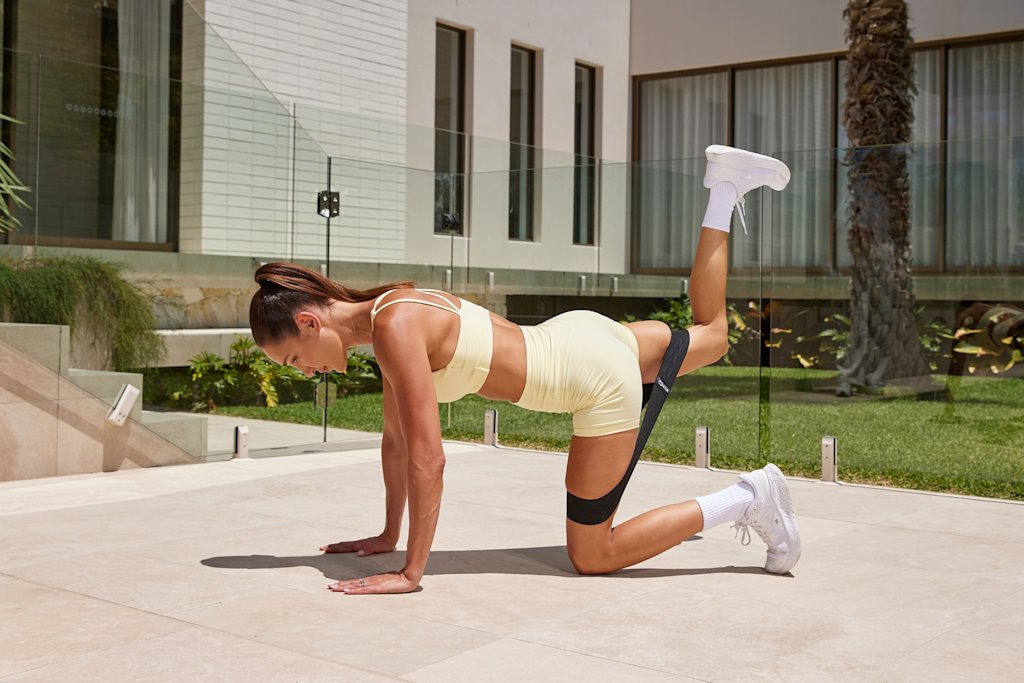
Start on all fours with a neutral spine, with an optional short band looped above your knees. Keeping your knees bent and your feet flexed, lift one leg behind you until your thigh is parallel with the floor, squeezing the glute at the top. Lower without letting your knee touch the mat. You'll often see people using momentum for donkey kicks like they're trying to break through the ceiling, but that's not correct form. Keep it nice and controlled.
5. Banded lateral walk: 10 steps each direction
Also called a crab walk. Band looped around your lower thighs, feet hip-width apart, then drop into a half squat. Step one foot out to the side, then bring the other in to follow, keeping enough of a gap between your feet so the band stays under tension the whole time. Stay in your half squat and resist the urge to stand up until you've finished all your steps. It burns, but in the best way.
6. Banded squat: 15 reps
Place the band just above your knees with your feet hip-width apart. Squat to a comfortable depth while actively pushing your knees out against the band. This one bridges the gap between activation and your first working set, so it's a good last move before you load up.
The 5-minute glute activation warm-up
Most strength workouts in the Sweat app include activation work or warm-up exercises, but this six-move warm-up is great if you want an easy five-minute sequence to do before any lower-body session, a run, or even during a break when you're working from home.
| Order | Exercise | Reps |
|---|---|---|
| 1 | Glute bridge | 15 |
| 2 | Single-leg glute bridge | 10 each side |
| 3 | Clam | 10 each side |
| 4 | Donkey kick | 10 each side |
| 5 | Banded lateral walk | 10 each direction |
| 6 | Banded squat | 15 |
Floor work first, then standing. One round is enough, but go for two if you're feeling particularly stiff or you've come straight from your desk.
If you've got time, we recommend then starting your workout with light to moderate weights as a warm-up before your first heavy working set. There's a reason for the gap: a 2015 study in the Journal of Human Kinetics found the benefit of a low-load gluteal warm-up on force production showed up around eight minutes afterwards rather than straight away.
How do you know if your glutes are actually working?
You're looking for a warm, slightly fatigued feeling in the meat of your glute, not in your lower back, hip flexors or quads. A gentle burn during the last few reps is exactly right.
If you can't feel much, try this:
Slow down. Most people rush activation work and lose the tension and control that makes it useful.
Add a band, or move up to a heavier one.
Rest a hand on the glute you're working for some physical feedback. You should feel the muscle working.
Pause and squeeze at the top of every rep for one or two seconds to build that mind-muscle connection.
Reduce the weight. If your weights are heavy but your glutes aren't feeling it, they're likely not strong enough, so other muscles (like your quads) are compensating. Go lighter and lift weights your glutes can handle until they're stronger.
Feeling glute bridges mainly in your hamstrings? Try walking your feet slightly closer to your body before you press your hips up.
Still can't feel anything, or you've got ongoing back or hip pain? Definitely worth seeing a physio!
Do you need a resistance band for glute activation?
No, but it makes a real difference to the side-to-side moves in particular.
The bridges and donkey kicks work fine with bodyweight. The clam, lateral walk and banded squat all rely on resisted hip abduction, which is exactly the pattern the research found produces the highest gluteus medius activity. You'll still get some benefit without a band, just less of it.
If you're buying one, a short looped fabric band is most useful for glute work. They don't roll or pinch the way thin latex ones do.
A few minutes now, better lifts later
Make these a non-negotiable part of your warm-up before lower-body days and you'll notice the difference pretty quickly. Glute activation can lead to better muscle engagement, stronger lifts, and fewer lower back niggles.
You don't need to overcomplicate it. Five minutes of activation, then get on with your session, and finish with a few glute stretches in your cool-down.
A more empowered you starts with Sweat, and our editorial team is here to bring you the latest fitness tips, trainer recommendations, wellbeing news, nutritional advice, nourishing recipes and free workouts.
* Disclaimer: This blog post is not intended to replace the advice of a medical professional. The above information should not be used to diagnose, treat, or prevent any disease or medical condition. Please consult your doctor before making any changes to your diet, sleep methods, daily activity, or fitness routine. Sweat assumes no responsibility for any personal injury or damage sustained by any recommendations, opinions, or advice given in this article.
Fitness